Planet Nine: The World We Still Haven’t Found
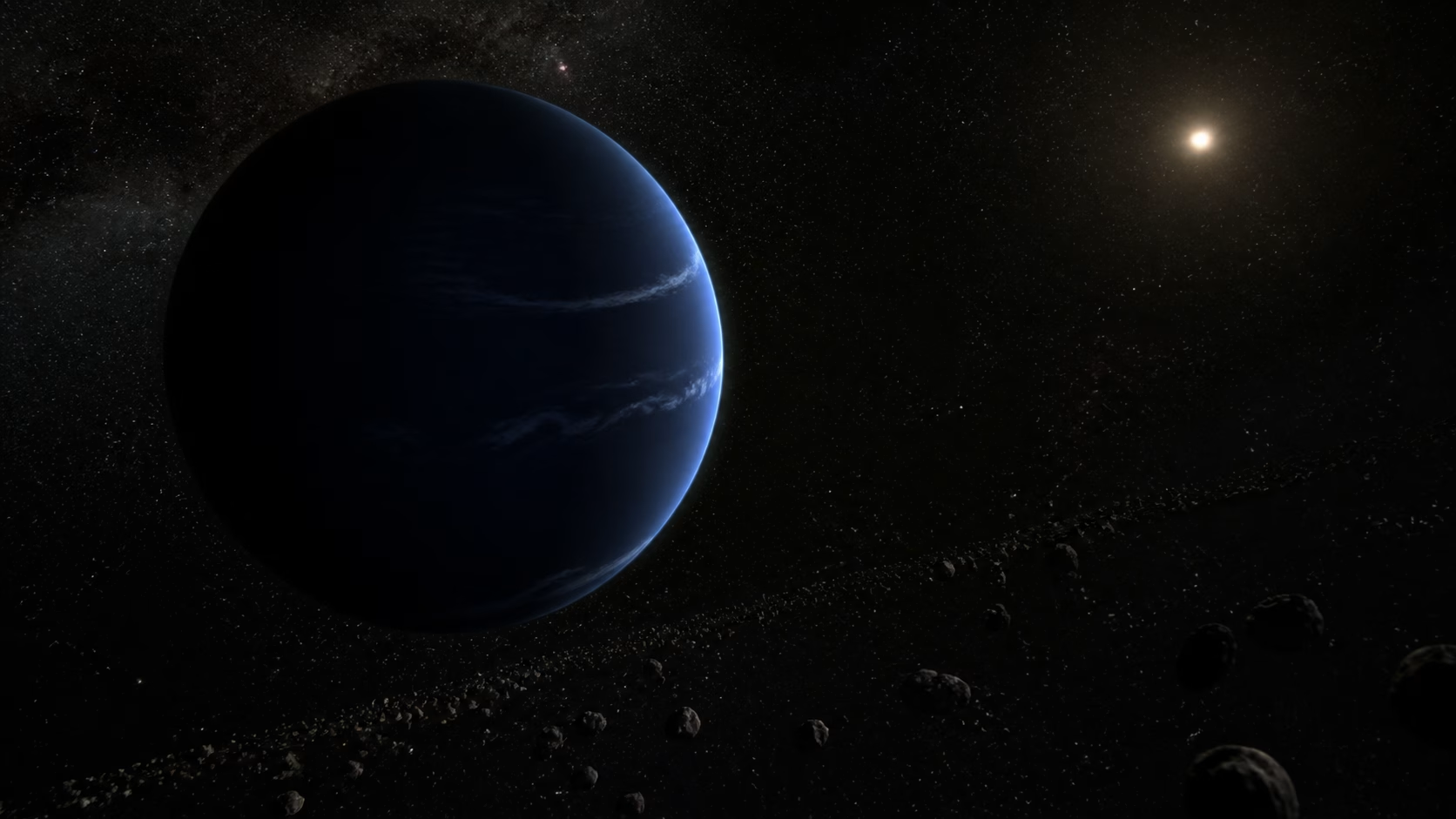
There may be a large planet circling the Sun so far away that no telescope has recognised it. It would not be hiding behind a permanent object or inside a dark cloud. It would simply be faint, slow and buried among millions of points of light.
The proposed world is called Planet Nine. It has never been directly observed. The Planet Nine evidence comes from the unusual orbits of small frozen bodies beyond Neptune, some of which appear to cluster in ways that may be difficult to explain by chance.
If the planet exists, it could be several times the mass of Earth and take thousands of years to complete one orbit. Finding it would rewrite the map of the Solar System. Failing to find it would force astronomers to explain the same orbital puzzle another way.
The strange objects beyond Neptune
The Kuiper Belt contains icy bodies left from the Solar System’s formation. Pluto is its most famous member, but many objects travel on much more distant and elongated paths.
A handful of extreme trans-Neptunian objects have perihelia—the closest points of their orbits—far enough from Neptune that the giant planet should not control them strongly. Their orbital directions also seem grouped rather than randomly distributed.
In 2016, astronomers Konstantin Batygin and Michael Brown argued that the gravity of an unseen planet could shepherd these objects into the observed pattern.
The proposal did not begin with an unexplained dot in a photograph. It began with gravity.
What Planet Nine might be like
Models often place the hypothetical planet at five to ten Earth masses. It might resemble a smaller version of Neptune, with a rocky and icy interior surrounded by a thick atmosphere.
Its average distance could be hundreds of times the Earth-Sun distance, although the predicted orbit is broad and elongated. At that range, sunlight would be extremely weak. The planet would appear faint even if physically much larger than Earth.
Its slow movement creates another problem. Nearby asteroids reveal themselves by shifting between images taken on different nights. Planet Nine might move so little that it resembles a fixed background star unless observations are carefully timed.
Why orbital clustering is persuasive
A massive distant planet could shape smaller orbits over billions of years. Computer simulations show that certain Planet Nine configurations can preserve clusters resembling those observed. The same model can produce highly inclined or even retrograde objects whose paths are difficult to explain through Neptune alone.
This ability to account for several features at once makes the hypothesis attractive. A good scientific explanation should do more than fit the pattern that inspired it; it should predict additional observations.
Some later discoveries have matched broad predictions, but the sample remains small and observational bias is a serious concern.
The bias problem
Outer Solar System surveys do not observe the whole sky equally. Telescopes avoid the bright Milky Way, operate during particular seasons and scan regions chosen for earlier projects. Weather, latitude and instrument sensitivity also influence where objects are found.
If surveys repeatedly examine one part of the sky, the resulting orbit catalogue may appear clustered even when the true population is not.
Several teams have argued that selection effects can explain much or all of the apparent alignment. Others find that the clustering remains statistically unlikely after accounting for survey bias.
The debate cannot be settled by confidence alone. It needs a larger, well-characterised sample.
Why haven’t we seen it?
The search region covers a vast area. Predictions constrain the orbit but do not point to one precise location. Depending on its position, Planet Nine may lie against a crowded star field or in a region that previous surveys did not reach deeply enough.
A planet at the far end of its orbit would be especially faint. Clouds in its atmosphere and its surface reflectivity would also affect brightness.
Existing astronomical archives may already contain it. Finding a slowly moving object can require comparing images separated by months or years and accounting for changes in instruments and sky conditions.
What else could explain the orbits?
Planet Nine is not the only idea. The clustering may be a statistical accident enhanced by biased surveys. Gravitational interactions among many small bodies could produce some structure, although the known Kuiper Belt may not contain enough mass.
A distant disk of unseen objects has been proposed. Some researchers have explored whether a primordial black hole could provide the gravity, but that idea adds major assumptions and currently lacks direct evidence.
There may also be several smaller planets rather than one large world. The early Solar System likely ejected many bodies; not every survivor needs to resemble the neat eight-planet arrangement we know.
How Rubin can change the search
The Vera C. Rubin Observatory is designed to photograph the southern sky repeatedly with exceptional depth and a wide field. Its Legacy Survey of Space and Time should discover vast numbers of moving objects.
Even if Rubin does not image Planet Nine directly, it can expand the sample of distant Kuiper Belt objects. A larger, less biased catalogue will show whether the orbital clustering becomes stronger or dissolves.
That makes the search scientifically valuable in either outcome. Confirmed clustering strengthens the case for an unseen perturber. Randomised orbits weaken it.
A mystery that can be solved
Planet Nine differs from many cosmic mysteries because it is testable. The proposed object must influence orbits, reflect or emit some light and occupy a finite region of the sky.
The search may take years, but it does not depend on belief. Either a moving point will eventually follow the predicted orbit, or improved observations will remove the need for it.
Until then, the Solar System’s edge remains unfinished. There may be eight planets—or one more world travelling so slowly through the dark that an entire human lifetime is barely a moment in its year.
Related reading

latest video

news via inbox
Subscribe to our Cosmic newsletter to get notified when we have new articles.