Göbekli Tepe Beyond the Myths: What the Evidence Really Shows
Göbekli Tepe is often introduced as a place that should not exist: an enormous temple built by wandering hunter-gatherers before agriculture, cities or organised religion. That description captures the wonder of the site, but it also freezes archaeology in an outdated argument.
The real Göbekli Tepe is more interesting. Its builders were not simple people suddenly handed advanced knowledge. They belonged to skilled communities living through one of the largest transformations in human history, when hunting and gathering, permanent settlement, cultivation and ritual life overlapped in new ways.
The best Göbekli Tepe facts do not remove the mystery. They replace a cartoon mystery with a human one: how did communities more than 11,000 years ago organise labour, carve monumental pillars and create shared places before the familiar structures of civilisation existed?
How old is the site?
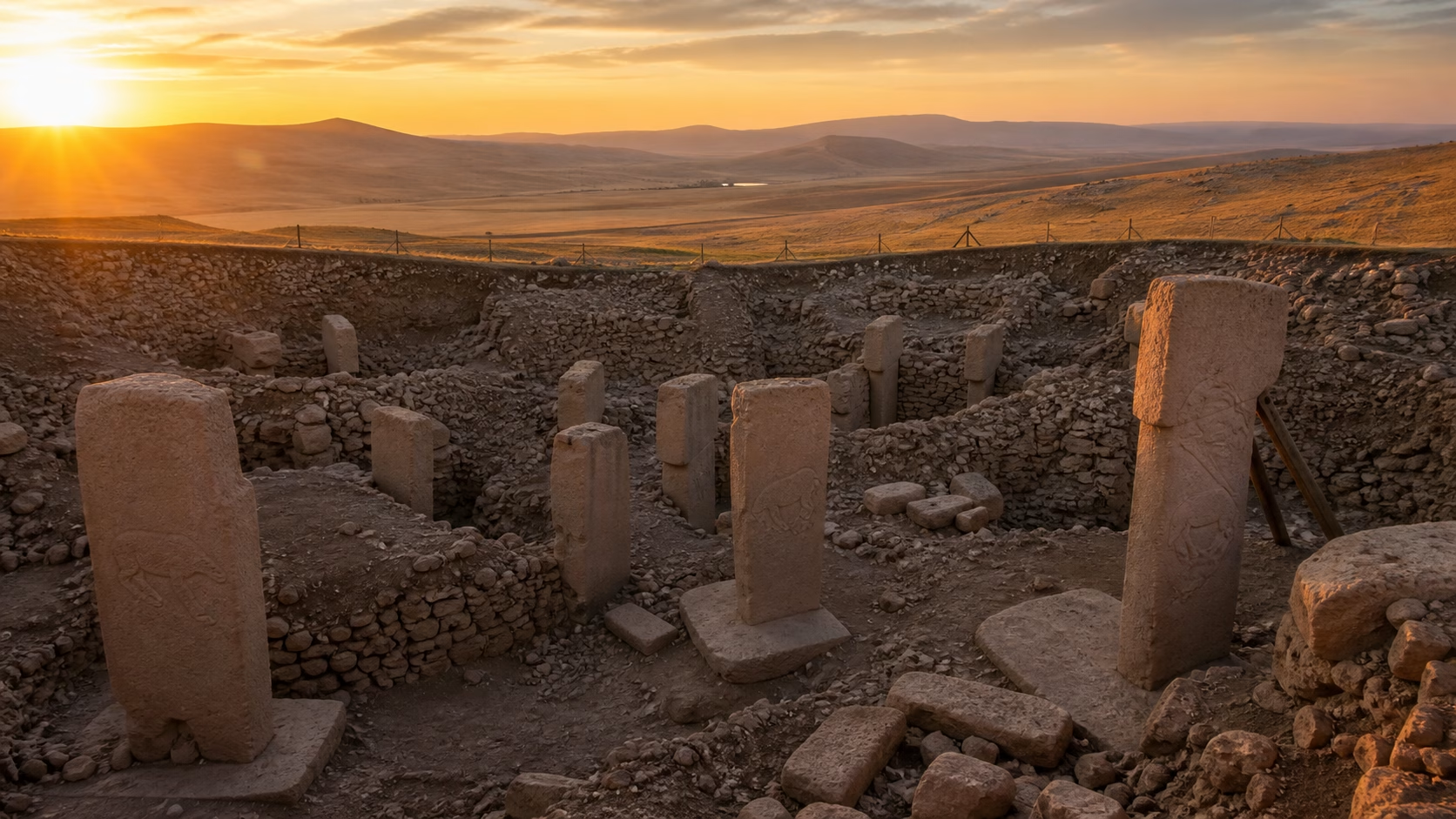
Göbekli Tepe lies in southeastern Türkiye, in the hills of Upper Mesopotamia. Its major structures date to the Pre-Pottery Neolithic, broadly between 9600 and 8200 BCE.
That makes the earliest monuments several thousand years older than Stonehenge and the Egyptian pyramids. They were built near the end of the last Ice Age, before metal tools and long before writing.
The site contains circular or oval enclosures as well as later rectangular buildings. Massive T-shaped limestone pillars stand inside them, some reaching about 5.5 metres. Many bear reliefs of wild animals, abstract signs, belts, hands and clothing.
Were the builders hunter-gatherers?
Yes, but the label can mislead. Hunter-gatherer does not mean socially simple, permanently nomadic or incapable of planning. Communities in the Fertile Crescent were becoming more settled and experimenting with plant management before fully domesticated crops dominated life.
Göbekli Tepe’s builders had detailed knowledge of stone, seasonal resources and the surrounding landscape. Quarrying, moving and raising pillars required cooperation, food and leadership. Those abilities do not require a kingdom; they require organised communities.
Recent excavation has also identified domestic-looking buildings and everyday material. This complicates the older idea of an isolated temple visited only for ceremonies.
Temple, settlement or both?
Early interpretations called Göbekli Tepe the world’s first temple. The monumental enclosures and carved pillars clearly had symbolic importance, possibly involving communal gatherings, ancestor traditions or funerary practices.
But “temple” is a modern category. The people who built the site may not have separated religion, home, food and community in the way we do.
Evidence of non-monumental structures suggests people lived or worked nearby. Buildings could change function over time. A space used for ceremony might also host meals, craft activity and political negotiation.
Archaeology increasingly treats Göbekli Tepe as part of a wider settlement landscape rather than a single mysterious sanctuary on an empty hill.
What do the T-shaped pillars represent?
Some pillars appear anthropomorphic. Carved arms extend along their sides, with hands meeting across the front. Belts and loincloths reinforce the impression of stylised human bodies without carved faces.
Two taller central pillars dominate several enclosures. They may represent ancestors, powerful beings, community figures or categories we cannot recover.
The animal reliefs include snakes, foxes, boars, birds and wild cattle. These were not random decorations. Their placement and repetition suggest a shared symbolic language, but no surviving text explains it.
Claims that the carvings encode a precise astronomical disaster are debated. Pattern matching can produce impressive alignments after the fact. A convincing interpretation needs consistent symbolism, secure dating and predictions that work beyond one chosen pillar.
Was the site deliberately buried?
Several enclosures were filled with stone, soil, animal bone and broken material. This led to the popular idea that the builders intentionally buried their temples in a single ritual event.
The reality may be more complicated. Some filling was probably deliberate, but it may have occurred in stages as structures were repaired, rebuilt or abandoned. Later activity disturbed earlier layers.
Careful excavation of the fill matters because it contains evidence of meals, tools, animals and construction history. Calling it merely “burial” can hide decades of changing use.
Did Göbekli Tepe come before agriculture?
The site belongs to the long transition toward farming. Early monuments were built by communities still relying heavily on wild animals and plants. Nearby regions contain some of the earliest evidence for cereal cultivation and animal domestication.
Older narratives proposed that agriculture created surplus, which then allowed monuments and organised religion. Göbekli Tepe showed that communal building could appear while subsistence was still changing.
This does not prove that religion invented agriculture. It suggests a feedback loop. Gatherings encouraged people to produce and store more food. Settled life made repeated construction possible. Shared ritual helped bind larger groups together.
Where the extreme claims go wrong
Göbekli Tepe is sometimes linked to Atlantis, lost high technology or extraterrestrial teachers. No excavated object requires those explanations. The pillars were worked with stone tools, and unfinished examples remain in nearby quarries.
Dismissing the builders’ achievement as impossible for hunter-gatherers underestimates them. Human communities can develop sophisticated architecture and symbolic systems without writing or metal.
At the same time, archaeology should not pretend every question is solved. We do not know the exact meaning of the enclosures, how authority worked or what stories the carvings preserved.
The wider Tas Tepeler landscape
Göbekli Tepe is not alone. Related sites across southeastern Türkiye—sometimes grouped under the name Tas Tepeler—contain T-shaped pillars, special buildings and similar imagery.
This wider network changes the question from “Who built this impossible isolated monument?” to “What was happening across this entire region?” Communities shared ideas, raw materials and probably marriage and exchange networks.
The emergence of monumental building was a regional development, not a single flash of unexplained knowledge.
The real reason Göbekli Tepe matters
The site forces us to rethink civilisation without inventing a vanished super-civilisation. Monumental architecture did not wait for kings. Shared symbolism did not wait for writing. Large projects did not wait for cities.
Göbekli Tepe’s builders were fully human, and that is the extraordinary part. They transformed stone, landscape and memory at the edge of a new world.
Related reading


latest video



news via inbox
Subscribe to our Cosmic newsletter to get notified when we have new articles.