
Delft Controls One Atom’s Nuclear Spin—and Finds a New Puzzle
A quantum memory needs an awkward combination of qualities. It must keep information protected from outside interference, yet still respond when someone wants to write or read it. The nuclear spin inside an atom offers the protection. Getting a useful signal in and out is the difficult part.
A new Delft-led experiment has brought that problem down to one atom on a surface. Using a scanning tunnelling microscope, researchers resolved nuclear magnetic resonance in a single titanium-47 atom. They also addressed its nuclear spin when mixing with the electron spin was weak—a regime that makes control especially interesting.
The study by Hester G. Vennema, Cristina Mier and colleagues appeared as a peer-reviewed accepted article in Nature Communications on 24 October 2026. TU Delft described the result on 27 October. It is a precise laboratory demonstration with an unresolved mechanism to investigate, rather than a ready-made quantum computer.
What nuclear spin offers quantum information
Spin is an intrinsic quantum property with magnetic consequences. The common comparison to a tiny compass is helpful for understanding how a spin can respond to a field. It should not be taken literally as a miniature rigid ball spinning inside the atom.
Nuclear spins can be comparatively well isolated from their surroundings. The paper identifies that isolation as a reason they are promising for quantum information technologies: their states can be long-lived. However, the same separation that helps preserve a state makes controlling and reading it more challenging.
This is a general design tension. A system that is easy to disturb may be easy to address, but difficult to use as a memory. A system that barely responds may preserve information well while giving an experimenter very little access to it. Instead, useful control sits between those extremes.
Two signals let researchers examine one atom
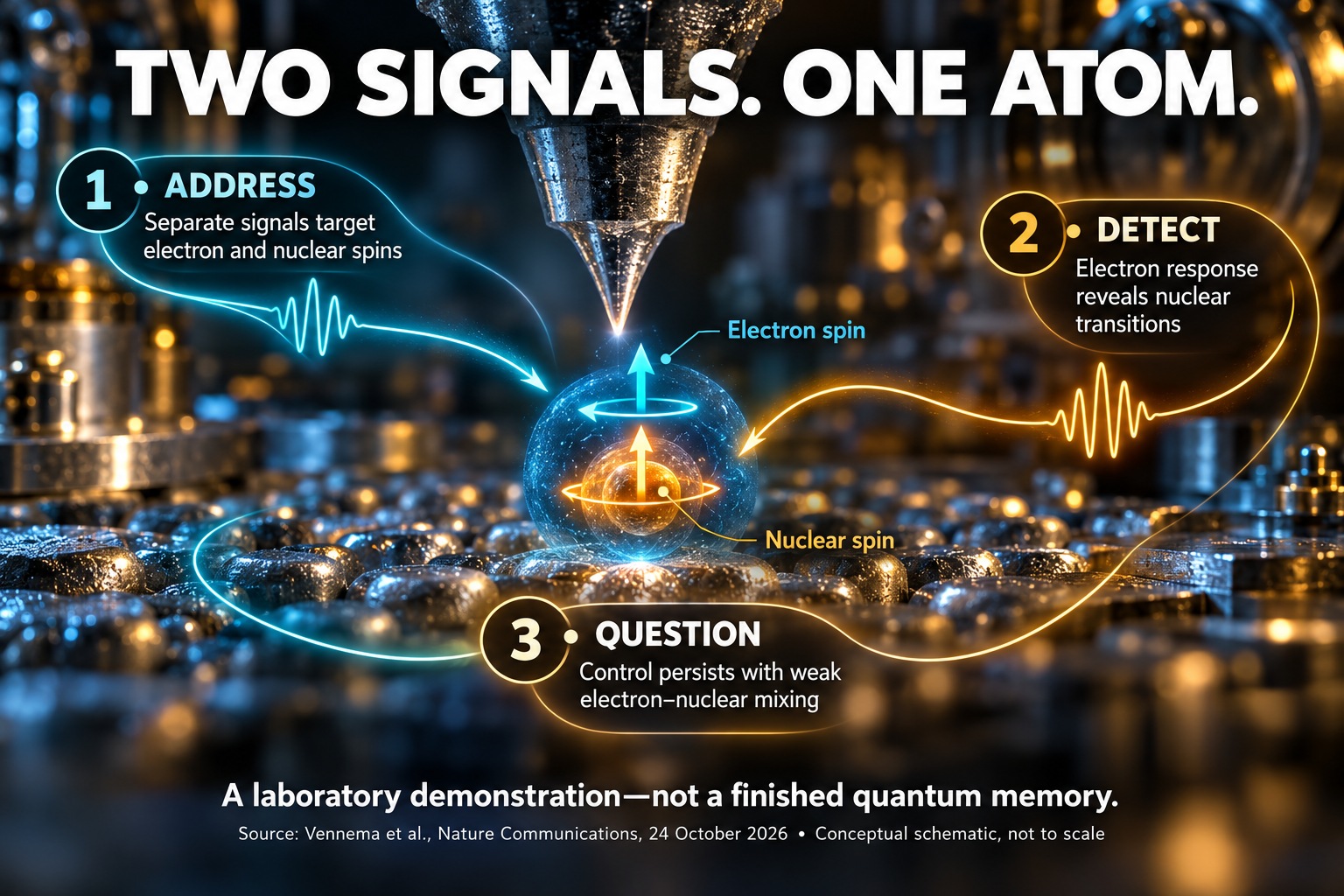
The team used an electron–nuclear double-resonance scheme. One signal addressed the electron spin and another addressed nuclear transitions. Watching the electron response provided a way to investigate what was happening in the nucleus.
The team chose titanium-47. Its nucleus has a spin quantum number of I = 5/2. That detail matters: “a single atom” does not mean the researchers had an arbitrary atom with a simple on-or-off nucleus. The isotope provides a particular set of nuclear spin states and transitions to study.
A scanning tunnelling microscope supplies highly local access. Its probe can address an atom on a surface, rather than collecting the average response of a vast sample. In this experiment, the researchers combined that local approach with two resonance signals.
Resonance requires the appropriate frequency. A radio receiver is a familiar analogy: tuning determines which signal a receiver selects. The analogy is limited, but it explains why sending energy towards the atom is not the whole procedure. The frequency must address a transition the system can actually make.
Why the weak-mixing result was unexpected
Electron and nuclear spins interact within an atom through hyperfine coupling. The paper uses measurements and numerical analysis to investigate that coupling alongside a quadrupole interaction. Together, these interactions help determine the nuclear transitions observed in this particular system.
The especially interesting observation was nuclear control in a limit where the nuclear and electron spin states mix only weakly. The researchers describe access to that regime as a requirement for direct nuclear control where researchers want long lifetimes.
TU Delft’s explanation emphasises the surprise. The team could flip the nuclear spin even when the spins were largely disentangled, despite a simple picture suggesting that the nucleus should barely respond to the microscope’s electrical signals. The university says the driving mechanism remains a question for further investigation.
That is a reason for careful follow-up. An unexpected response can reveal that a model leaves out an important interaction. It does not by itself overturn quantum mechanics. Here, both the measurement and the effort to explain it take place within an established quantum framework.
Nuclear spin control is one step towards a memory
Three questions help keep the implications in proportion. How precisely can researchers prepare a state? Can they measure it reliably? And can a larger system preserve and use it? Progress on one question can support the others without answering all of them.
A related 2025 Delft-led study examined single-shot readout of an on-surface nuclear spin. The 2026 work addresses resonance and control. These are related capabilities. However, those separate experiments do not establish that a complete practical memory has already arrived.
Scaling also changes the engineering problem. A useful device needs more than an isolated successful operation: it needs repeatable preparation, reliable measurements and a way to coordinate many relevant operations. Those are criteria to assess in future demonstrations, rather than achievements established by this single result.
Our report on a silicon quantum processor with control electronics inside its cryostat explores that broader systems challenge. It concerns a different platform and should not be treated as the next stage of the titanium experiment. Both stories show why control hardware matters alongside the quantum element itself.
What to watch next
The immediate scientific question is how the local signals produce the observed nuclear response in the weak-mixing regime. A more complete account should help researchers understand when that control is available and how to use it without losing the isolation that made the nucleus attractive in the first place.
The publication itself deserves a date check, too. At the time of this report, Nature labels it an early version of peer-reviewed, accepted research, with further editing before the final Version of Record. It is citable and has a permanent DOI. That status is different from an unreviewed preprint, while still leaving readers reason to check the updated record.
The achievement is small in physical size and substantial in experimental precision: researchers have addressed magnetic behaviour inside one atom with a local probe. Above all, its value lies in the new control and the questions it makes possible. Researchers will judge the next advance by how clearly it answers those questions.
Sources and further reading



latest video



news via inbox
Subscribe to our Cosmic newsletter to get notified when we have new articles.