Shanidar A: What a Neanderthal Shoulder Blade Can Tell Us
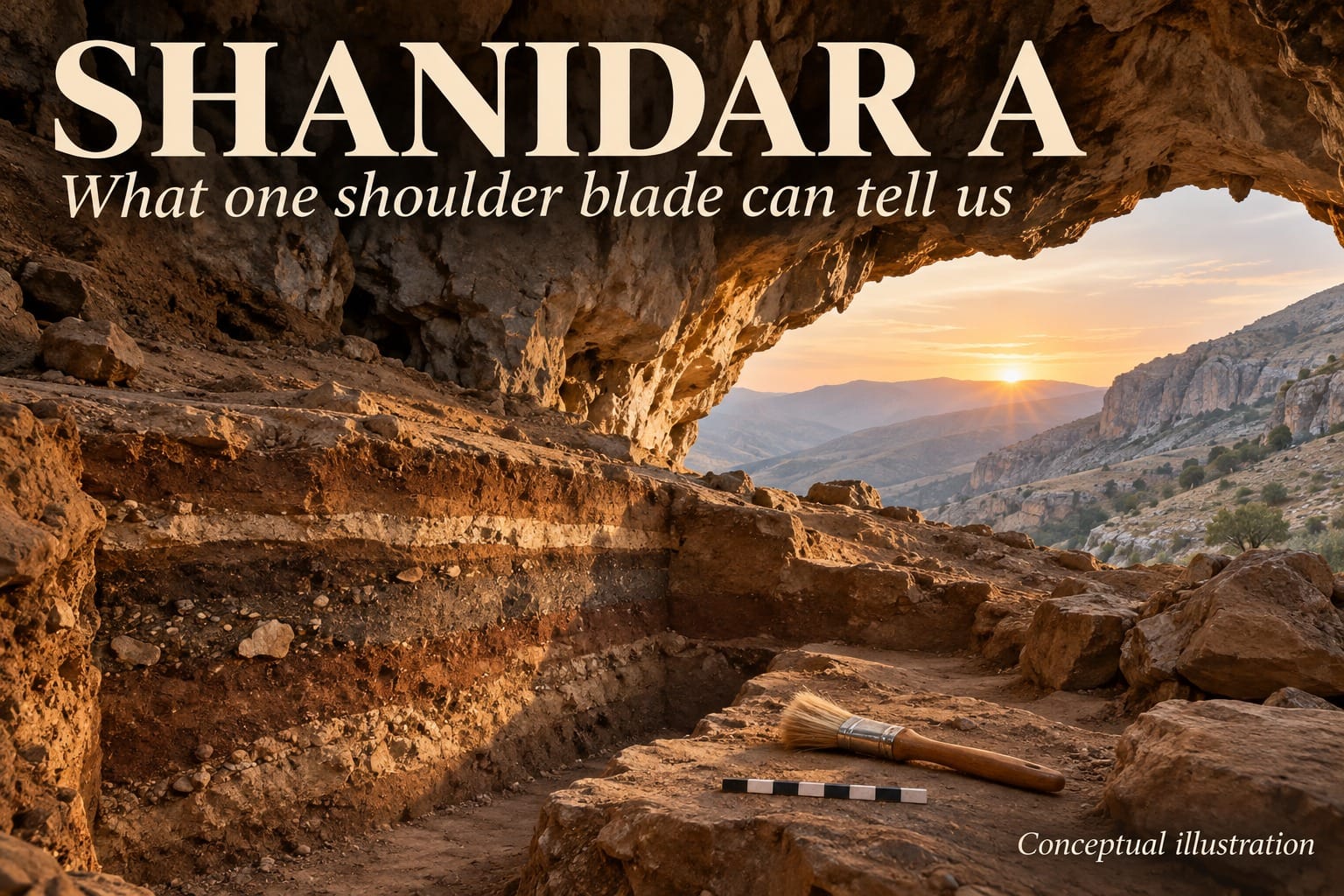
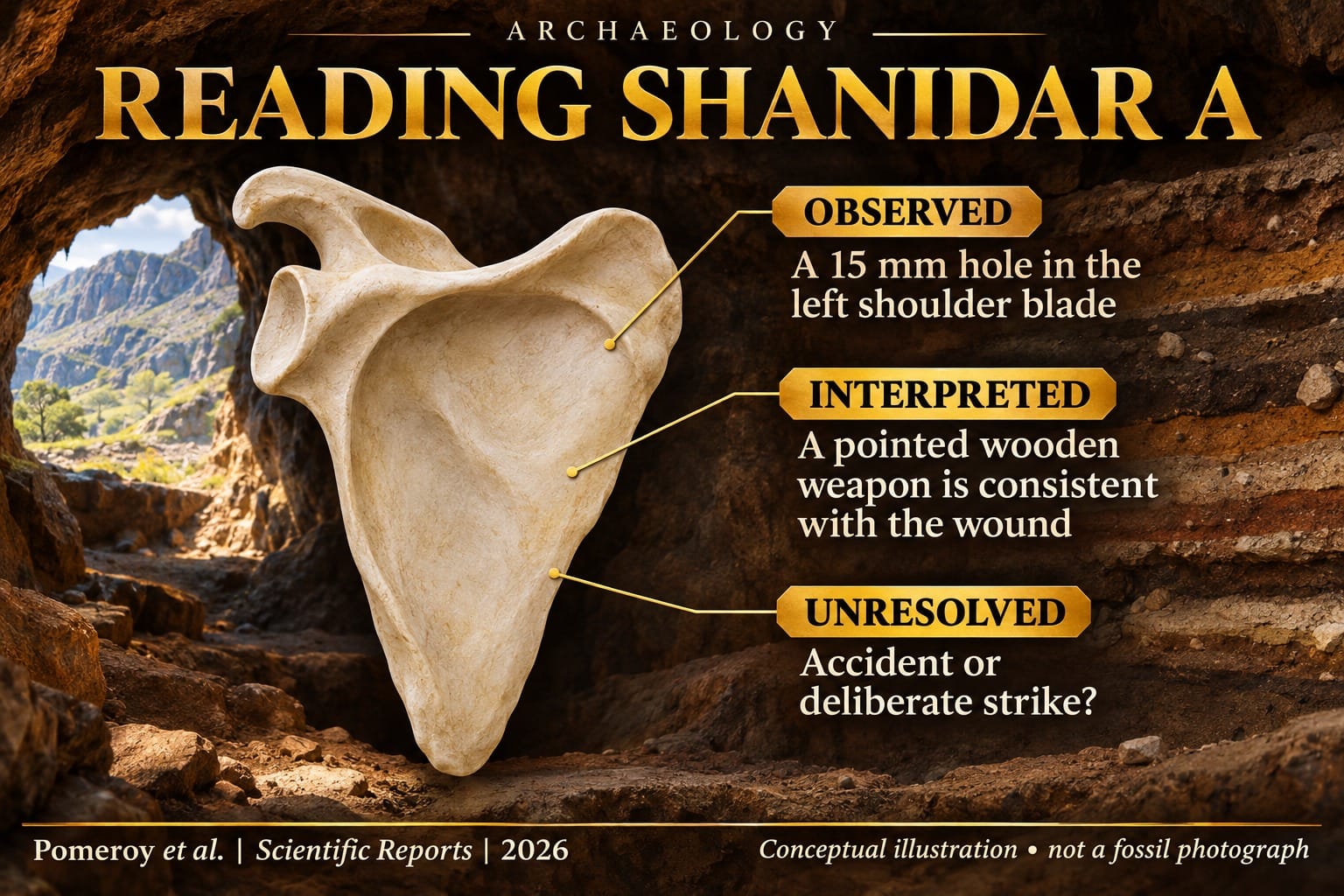
The most revealing part of a Neanderthal skeleton from Shanidar Cave is a hole about 15 millimetres across. It passes through the left shoulder blade. The edge of the opening and the way the bone broke give researchers a way to ask what happened roughly 75,000 years ago. The shape of the wound can tell them more about the object that caused it than about the person who wielded it.
What researchers found at Shanidar Cave
Shanidar Cave lies in the Zagros Mountains of Iraqi Kurdistan. The remains now called Shanidar A were recovered during excavations in 2019 and 2022, in an area that already held several Neanderthal individuals. The team describes Shanidar A in an October 2026 study in Scientific Reports. The letter is a specimen label. It does not refer to Shanidar Z, the individual whose reconstructed face became widely known, or to Shanidar 4, the skeleton associated with the old flower burial debate.
The pieces of Shanidar A’s skeleton were not all where they would have been in life. The researchers found evidence that moving water disturbed the remains after the body had decomposed. Even so, the left shoulder blade was nearly complete. Its survival lets the team look at how the bone broke and distinguish damage around the time of death from the later processes that scattered parts of the skeleton.
Why a wooden spear fits the injury
The opening is roughly round, with bevelled edges and displaced fragments. The team reconstructed how force could have passed through the shoulder blade and concluded that a pointed implement could have struck from the front. A sharpened wooden spear fits the fracture pattern. No spear was recovered with the bones, so the proposed material and shape come from the wound itself and comparisons with experimental injuries.
That distinction matters. The authors consider the injury likely to have been fatal, but the surrounding soft tissues have not survived. A path through the bone cannot tell us exactly which tissues were damaged. It cannot tell us whether the person was facing a hunter, was caught in an accident or was deliberately attacked. Even the suggested direction describes the path through the body, rather than where anyone stood in the cave or how the weapon was used.
A split tooth tells a slower story
A lower front tooth provides evidence of an earlier injury. It split badly enough to expose an inner surface. Mineralised dental plaque had time to build up on that surface. A crack caused by excavation or burial would not have acquired plaque in a living mouth. That makes the tooth a useful contrast to the shoulder wound: one injury left evidence of survival; the other left evidence of a penetrating impact around the time of death.
As the Cambridge team explains, the tooth damage may have made eating painful. The person could have adjusted what they ate, and help from others is possible. The tooth cannot tell us who prepared a meal, how often help was needed, or how long that help lasted.
What the burial context adds
Shanidar A was found below nearby Shanidar Z. The study places the remains within a cluster that represents at least five individuals. The positions are informative even after water disturbance, but they do not preserve a complete account of how bodies came to be placed there. Archaeologists make similar distinctions between a deposit and later changes to it at very different sites, as in the excavations at Kabul’s Bala Hissar fortress.
Was Shanidar A murdered? The evidence cannot settle the question. What makes the find valuable is the contrast between two things that can be investigated: a blow that pierced bone around the time of death and a dental injury that the person lived with. Both leave physical traces. The circumstances of the blow remain open.



latest video



news via inbox
Subscribe to our Cosmic newsletter to get notified when we have new articles.