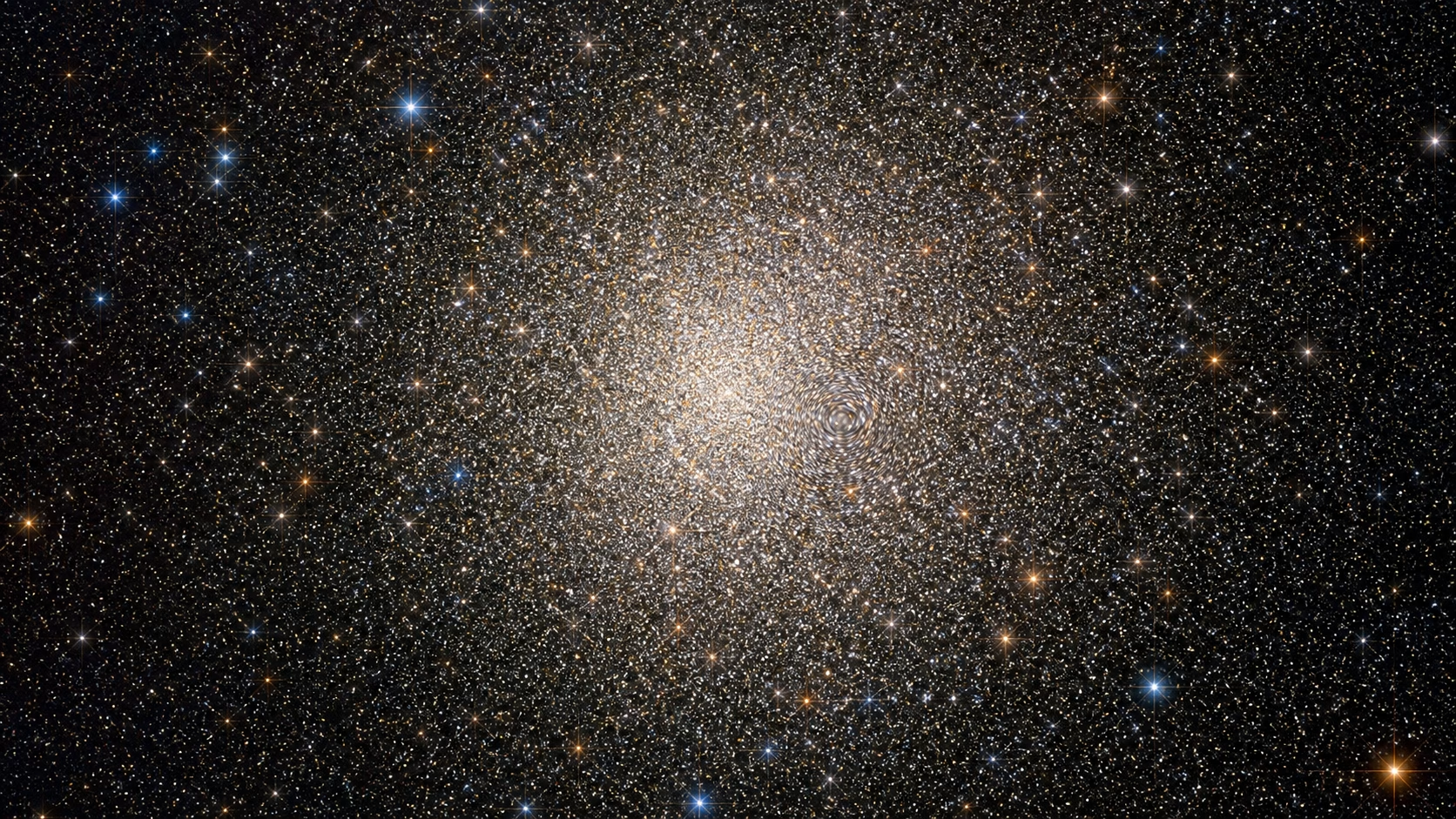
Hubble Finally Found One of Omega Centauri’s Missing Black Holes
Omega Centauri should contain a large population of black holes. For decades, however, astronomers struggled to find even one. That changed in July 2026 when a team using more than twenty years of Hubble observations and supporting Webb data identified the first convincing Omega Centauri black hole of stellar mass.
The discovery is not a dramatic image of a dark sphere. It comes from the motion and brightness of a star trapped in a close orbit around an invisible companion.
A city of ancient stars
Omega Centauri is the largest globular cluster in the Milky Way. Roughly ten million stars are packed into a sphere about 150 light-years across, creating a crowded environment unlike the quieter region around our Sun.
Many of those stars are ancient. The most massive members completed their lives long ago, exploding or collapsing and leaving neutron stars and black holes behind. Models therefore predict that the cluster should contain a substantial population of stellar-mass black holes.
Why were the black holes missing?
A black hole in a dense cluster is difficult to see unless it actively feeds on gas from a companion. Most do not. Astronomers must instead detect their gravitational influence on nearby stars.
The cluster’s density makes that task challenging. Stars overlap in images, and their motions must be measured across many years. Short observations can confuse orbital movement with the ordinary drift of stars through the cluster.
There is also a physical complication. Repeated gravitational encounters can kick black holes out of a cluster. The long absence of detections raised a real question: had Omega Centauri lost most of its remnants, or were they simply hiding?
The clue was a star with a changing rhythm
The newly found system includes a star whose light varies. Hubble’s long archive allowed researchers to track both its position and its changing brightness. The star’s motion indicated that it orbits an unseen massive object.
Webb added sensitive infrared observations that helped separate the target from surrounding stars. Together, the data ruled out ordinary companions and pointed to a stellar-mass black hole.
This illustrates the value of astronomical archives. A discovery made in 2026 can depend on images collected before the research question was fully formed. Time becomes an instrument: the longer the baseline, the more clearly tiny motions emerge.
Stellar-mass or intermediate-mass?
Omega Centauri is also central to another debate. Some studies suggest that an intermediate-mass black hole—heavier than the remnants of individual stars but lighter than a galactic supermassive black hole—may sit near the cluster’s centre.
The new object does not settle that question because it belongs to the stellar-mass class. However, finding one confirms that at least some black holes survived in the cluster. A population of smaller black holes can influence the motions that researchers use to infer a single larger object, so every detection improves the model.
Was Omega Centauri once a galaxy?
The cluster is unusually massive and contains stars with a range of chemical compositions. Those properties have led astronomers to suspect that it may be the stripped core of a dwarf galaxy consumed by the Milky Way.
If true, Omega Centauri is not merely an oversized star cluster. It is the surviving nucleus of another system, preserving evidence of galactic cannibalism. Its black holes could reveal how compact remnants behaved during that transformation.
This idea connects Omega Centauri to the newly discovered wandering supermassive black hole in a distant galaxy. Both cases show how mergers can displace or preserve black holes in unexpected environments.
Why one detection matters
One black hole does not account for the whole predicted population, but it proves the search method works. Researchers can now apply the same combination of long-term Hubble astrometry, variable-star data and Webb imaging to additional candidates.
Each new system will help estimate how many black holes remain, how massive they are and how they are distributed. That distribution tests models of stellar evolution and gravitational interactions under some of the most crowded conditions in our galaxy.
The invisible universe becomes measurable
Astronomy often advances by learning to detect what cannot be photographed directly. Dark matter is inferred from gravity, exoplanets from starlight and black holes from the behaviour of nearby matter. The Omega Centauri black hole is another example of an invisible object made visible by patient measurement.
The discovery also complements research into the almost invisible galaxy dominated by dark matter. In both cases, the brightest objects tell only part of the story; the real structure emerges from motion.
After decades of searching, Omega Centauri has finally given up one of its hidden remnants. It is probably not alone.
Source: NASA Hubble: first of Omega Centauri’s missing black holes.


latest video


news via inbox
Subscribe to our Cosmic newsletter to get notified when we have new articles.